This revision supersedes the original abandoned design (live per-provider inventory queries with a split-screen YAML editor + precheck panel) and documents the as-built Bid Screening feature. The feature was originally named “Bid PreCheck”; it is now “Bid Screening” everywhere (route, feature flag, service, glossary). The
aep-67URL is unchanged.
Motivation
Users often see plenty of available GPUs on the pricing page but fail to receive any bids for their deployment. This causes users to think that the service is broken and likely give up on investigating further. Providing users guidance on why this is happening will go a long way in improving adoption.
Background
There are situations where Console users hit the GPU pricing page (on the website) or the providers page (in Console), see that there are enough “available” GPUs of the desired model, proceed to deploy via Console, only to NOT get ANY bids for their deployment. This can happen due to the following primary reasons:
- While there may be enough “available” GPUs in aggregate (across multiple providers), there may not be enough GPUs on a single provider.
- While there may be enough GPUs on a single provider, there aren’t enough (to fulfill the GPU count in the user SDL) on a single node of the provider. This can happen if past small requests (1-2 GPUs per deployment) happened to get scheduled across different nodes of the provider, leaving the provider “fragmented” in terms of available GPUs.
- While there may be enough GPUs on a single node to satisfy the GPU count, the specific node may not have enough other (non-GPU) resources available to satisfy all the resource requirements outlined in the compute profile. We have sometimes seen this happen when a provider’s CPU count gets maxed out (90%) with workloads while they have little usage of GPUs.
Users need to know — before they commit an on-chain transaction — whether their deployment is likely to receive any bids, and if not, why.
Proposed Solution
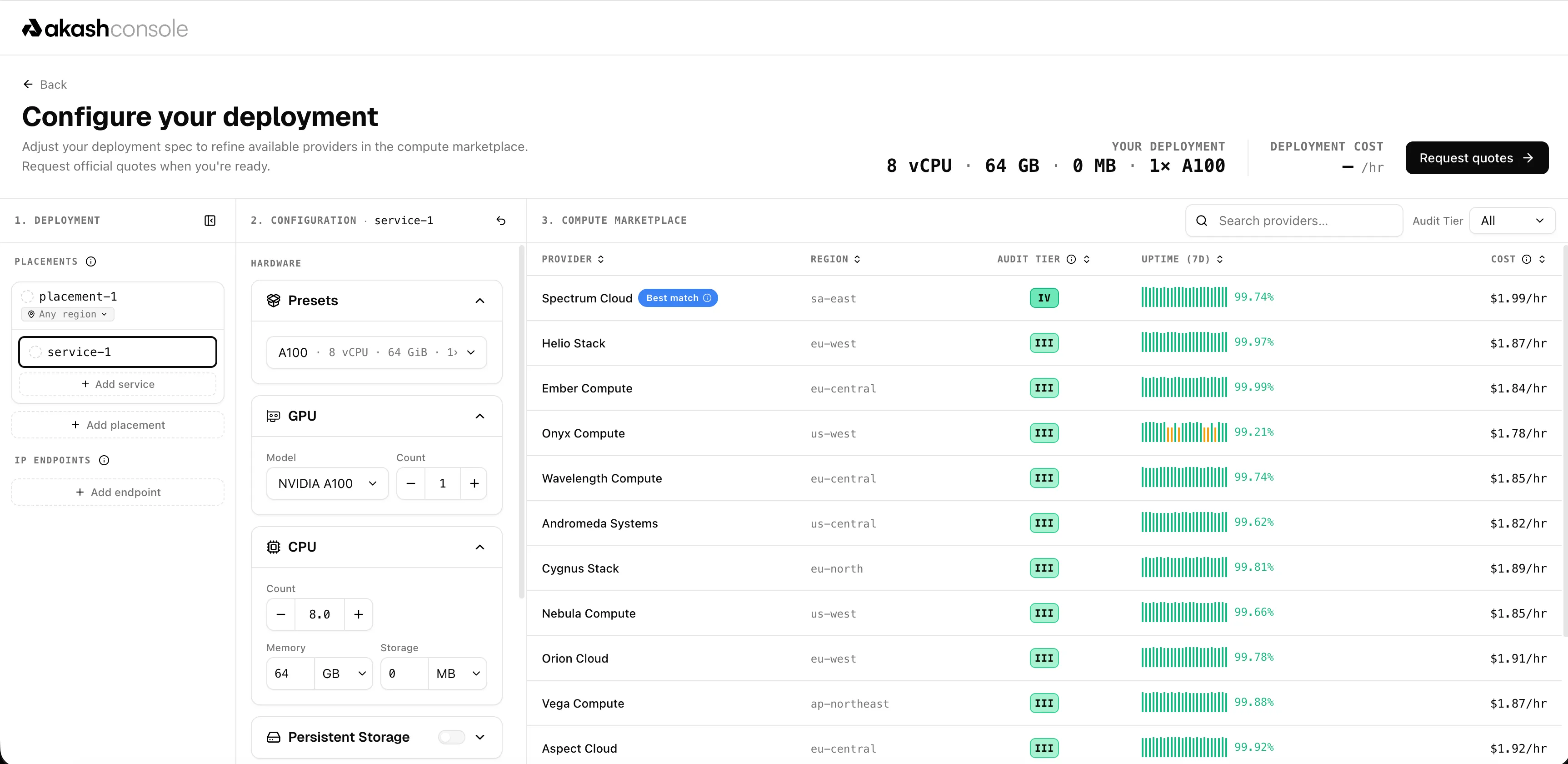
Bid Screening screens the provider set against a deployment’s requirements before the user creates the on-chain order, so the user only ever sees providers that would actually bid. Where the original proposal queried each provider’s inventory live and presented “adjust your SDL” suggestions in a split-screen editor, the shipped design screens against a continuously-maintained, indexed snapshot of provider inventory and surfaces the result inline in the new deployment flow.
User experience (new deployment flow)
The screened provider set is surfaced inside the redesigned, flag-gated deployment flow at /new-deployment/configure. As the user defines placements and services and edits their SDL, a marketplace pane shows the screened set of providers — those that would satisfy the deployment’s requirements right now. This replaces the original split-screen YAML-editor / precheck-panel idea.
When zero providers match, the flow surfaces why — which dimension excluded them (aggregate capacity, per-node GPU count, GPU model, CPU/memory headroom, storage class, attributes, or price) — so the user can adjust the SDL with intent rather than guessing.
How it works (backend)
Bid screening is backed by apps/provider-inventory, a single-replica service that maintains one denormalised provider_inventory row per active provider. A streamer inside that service holds long-lived streamStatus gRPC connections to every active provider and writes each provider’s current cluster state (rollup capacity columns, a JSONB inventory payload for the matcher, and self/signed attributes) into its row; a discovery loop polls the chain (~10 min) for new providers and audit attributes, and a 3-strike rule flips unreachable providers offline. This keeps a low-latency snapshot of “what could be leased right now” without fanning out to every provider on each request.
A screening request flows entirely over HTTP:
apps/deploy-webcallsapps/api’s publicPOST /v1/bid-screeningroute.apps/apiis a thin, feature-flagged proxy: it validates auth and forwards the request toapps/provider-inventory. No bid-screening domain logic remains inapps/api.apps/provider-inventoryruns two-stage matching:- A lossy SQL prefilter narrows candidates on cluster-aggregate and per-node-max-free dimensions (capacity, GPU model, attributes,
signedBy, storage class). It is intentionally lossy — it must never exclude a provider that would actually pass; false positives are fine. - A strict JS bin-packer is the final gate. It is a JavaScript port of the provider’s Go resource-matching algorithm — greedy per-node packing that honours GPU fragmentation, storage classes, and per-node resource limits — and decides whether each candidate cluster can actually host every replica.
- A lossy SQL prefilter narrows candidates on cluster-aggregate and per-node-max-free dimensions (capacity, GPU model, attributes,
Why indexed instead of live queries: querying every provider’s inventory live, per keystroke, does not scale on a decentralised network — fan-out latency and provider availability are unbounded. An indexed snapshot keeps screening bounded and fast (tens of milliseconds) and degrades gracefully when individual providers are unreachable.
Because the JS bin-packer must agree with what the provider’s Go implementation would decide via shouldBid, the two implementations have to stay aligned — see Future work.
For implementation depth, see the public ADR in the Console repo:
apps/provider-inventory/docs/adr/0001-streamer-fed-provider-inventory.md.
Architecture
Loading graph...
flowchart LR
    subgraph providers["Akash providers"]
        P1[provider]
        P2[provider]
        P3[provider]
    end

    subgraph pi["apps/provider-inventory (single replica)"]
        ST[streamer]
        DB[(provider_inventory)]
        PF["SQL prefilter (lossy)"]
        BP["JS bin-packer (strict)"]
    end

    P1 -- gRPC streamStatus --> ST
    P2 -- gRPC streamStatus --> ST
    P3 -- gRPC streamStatus --> ST
    ST -- UPDATE --> DB

    DW["apps/deploy-web /new-deployment/configure"] -- "HTTP POST /v1/bid-screening" --> API["apps/api proxy"]
    API -- HTTP --> PF
    DB --> PF
    PF -- candidates + inventory JSONB --> BP
    BP -- screened providers --> API
    API --> DW
The streamer’s streamStatus connections are the only gRPC in the path, and they are the ingest of provider state — not a per-request provider call. The screening request path itself is all HTTP. There is no provider-side gRPC precheck, no reservation-on-deploy, and no provider-proxy on this path.
Future work
To keep the Console JS bin-packer provably aligned with the provider’s Go shouldBid implementation, both should consume a set of shared, versioned matching fixtures — canonical (GroupSpec, inventory) → expected-decision cases checked in CI on both sides. This catches divergence between the two implementations before it reaches users and is the main outstanding hardening item.
Rollout
Bid screening is gated behind the BID_SCREENING feature flag in apps/api. The backend (apps/provider-inventory and the apps/api proxy) is built and running; the redesigned 3-pane deployment-flow UX that surfaces the screened set is being rolled out as part of the broader Console redesign effort. Rollout is staged: enable behind the flag, cut over /v1/bid-screening from the legacy in-process path to the proxy, then sweep the now-dead legacy bid-screening code out of apps/api.