GPU Compute for AI Inference and Training
Run containerized AI workloads on GPUs rented from independent providers. Use AkashML for OpenAI-compatible inference endpoints, or deploy your own container on Akash Console. No rate limits, no egress fees.

What it costs
Centralized inference APIs charge per token, with the vendor's margin built into the rate. Akash prices per GPU-hour, and the rate is set by providers bidding for your workload. You pay for the hardware and the power behind it.
AkashML runs on that same supply with a managed endpoint on top, so you get marketplace pricing without operating the deployment yourself.
| Centralized inference API | AkashML | |
|---|---|---|
| Supply | One vendor's data centers. | Independent providers across the network. |
| Pricing | Per token, set by the vendor. | Per GPU-hour, set by provider bids. |
| Scaling | Cost rises with traffic at a fixed margin. | Cost tracks hardware as volume grows. |
| Portability | Vendor-specific API. | Standard OCI containers, OpenAI-compatible endpoints. |
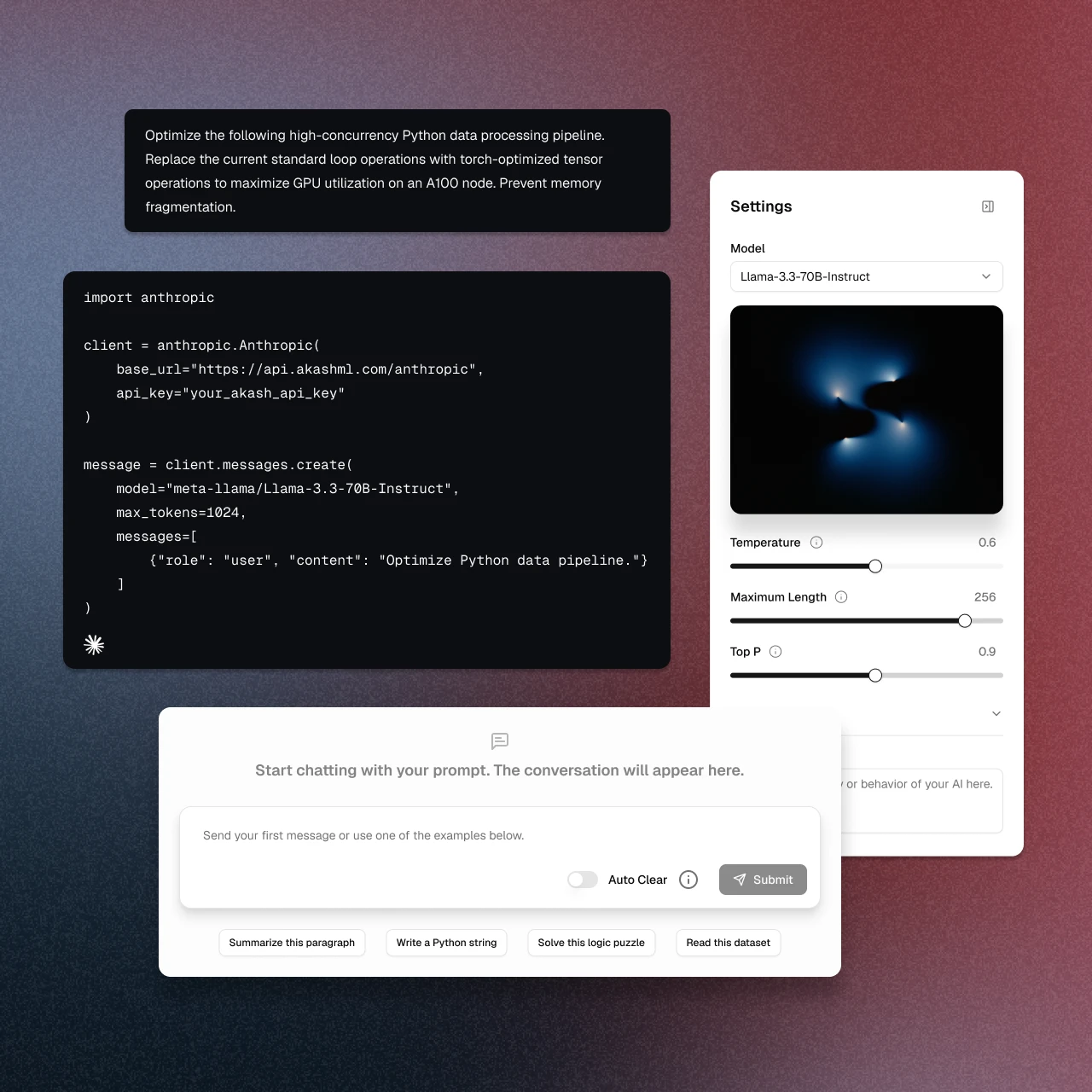
Inference without managing infrastructure
Access open-source models — Llama, DeepSeek, Qwen and others — through OpenAI-compatible APIs. Swap one base_url and your existing client code works. Sub-second latency, no cluster to run.
Built for production traffic
Concurrency
No rate limits
Hosted APIs cap requests per minute and drop traffic during spikes. On Akash your workload runs behind a load balancer across identical container instances. Throughput scales with the instances you run, not with a quota someone else sets.
Geography
Capacity in more than one region
Single-provider clouds tie you to one region's available hardware. Providers on Akash run in data centers worldwide, so you can place instances across regions and keep serving when any one region runs short.
Razer runs AVA Mini image generation on Akash
Razer integrated its open-source AIKit platform with Akash to scale the AVA Mini campaign. Distributed GPUs behind a single managed endpoint handled public launch traffic with no manual scaling.
$0.01
per generated image
3.24s
average end-to-end response time
15×
lower inference cost than centralized APIs
Figures reported by Razer, March 2026.
Read Case Study
"The future of AI isn't just better models – it's efficient infrastructure. With Razer AIKit, many use cases already run locally. With Akash Network, we extend that into a decentralised cloud to scale efficiently."
QUYEN QUACH
Vice President of Software, Razer
How it ran
Verified at scale in production with Razer.
The deployment
Razer packaged the AIKit runtime as standard OCI containers and ran them across consumer and enterprise GPU providers on the network.
The routing
AkashML handled load balancing across geographically distributed providers behind a single API endpoint.
The result
Through the public launch window the network sustained concurrent image generation with no downtime, averaging 3.24 seconds end to end under peak load.
FAQs
Providers on Akash run both consumer and data center GPUs. You can require a specific GPU model in your deployment file so only matching providers bid, and you can run several instances behind a load balancer so one node failing does not take the endpoint down. Razer's AVA Mini campaign ran on pooled consumer and enterprise GPUs through a public launch window with no downtime.
Yes. Your deployment file specifies GPU model and count — for example H100 only, or A100 and above. Only providers with matching hardware can submit a bid, and you choose which bid to accept.
If it runs in Docker, it runs on Akash. Point your deployment file at your existing image, declare the GPU, CPU, memory, and storage you need, and deploy. No SDK to adopt and no proprietary runtime.
Start building
Run your inference workload on a network of independent GPU providers. Deploy with one file. Scale without asking permission.